The Higher Power
Hide and Seek
October 2026
All passages below are my paraphrases from public domain translations, condensed for readability. Citations are there so you can check them. Specific numberings can vary across editions and translations. Dates cite textual compilation rather than the time of the teaching, if those vary.
Call it The Universe, God, The Tao, Aliens, or that something you know is out there but can't explain why. People have been looking for it as far back as records go, and it's a concept that appears across cultures. Those accounts tend to agree on some things; one of them is that our normal methods of searching, perceiving, and understanding won't work as well as we want them to. Eyes, words, and concepts will all come up short. Whatever it is won't be found next to the dry cleaning slip you've been looking for, and it'll be tough to tell your spouse about it over dinner.
I'm going to call it The Higher Power (THP), so I don't have to pick a team. If you've had an experience that convinced you something is out there, maybe this will help your search. If you're just here to see what this God-botherer is on about, the more the merrier. Either way, we've finished counting. Let's go look.
Teachings
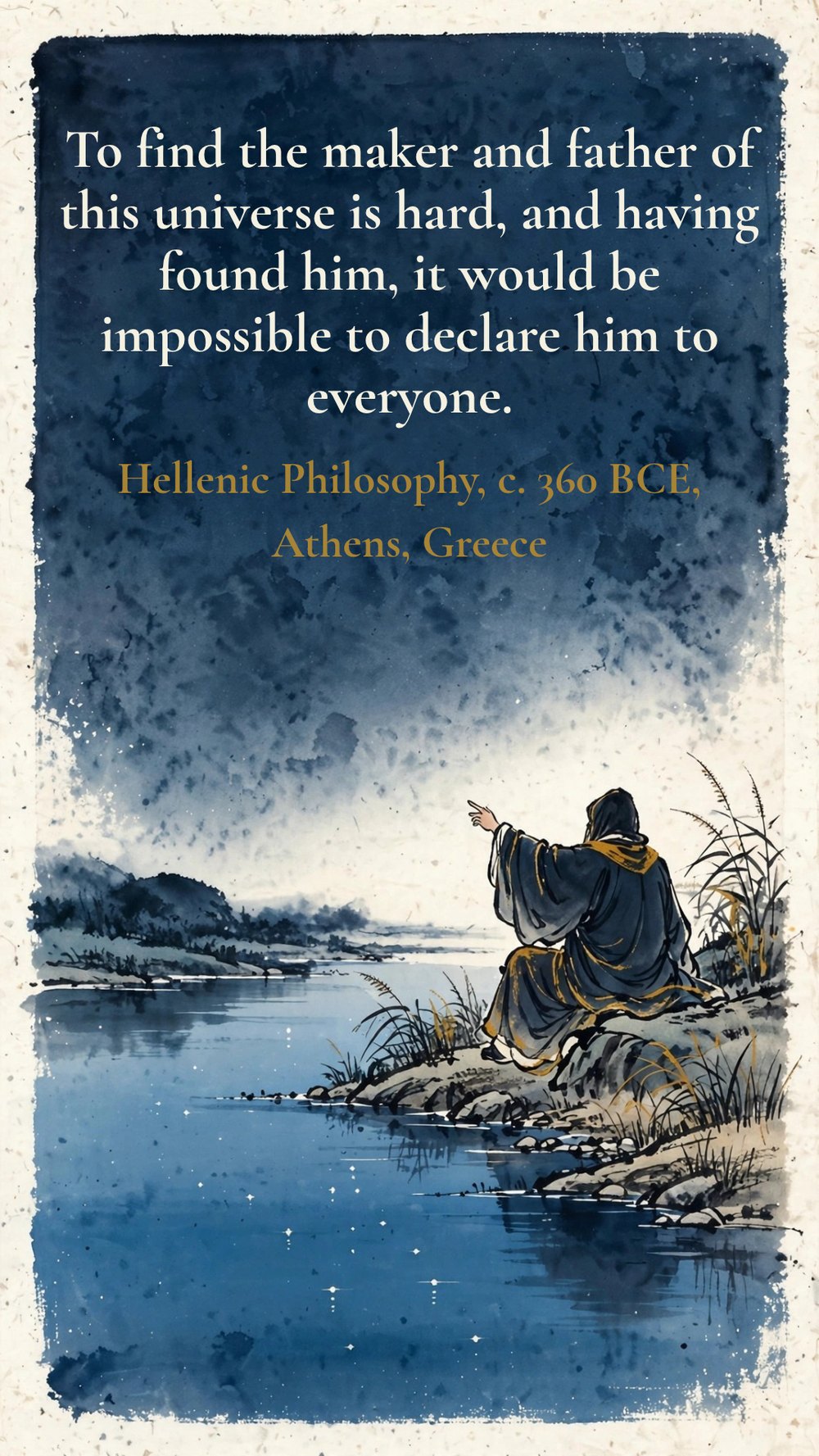
Plato, Timaeus 28c
Ironically, the man who just said it would be impossible to declare THP to everyone continues his lesson by doing exactly that. This won't be the only paradox we have to wrestle with today. This teaching is doing a few distinct things. Firstly, he takes a stance on what THP is: maker and father. The cosmos did not come from nothing or randomness. It was made purposefully. Secondly, he calls him father. I read this as an implication that Plato feels THP is somewhat actively involved and also cares about his creation. This stream of parental affiliation will run through a couple more teachings as well.
One interesting question about this teaching that has been debated is where the emphasis lies. Is THP impossible to declare, or is it impossible to declare to everyone? Or maybe both readings are true. We certainly know plenty of people that couldn't possibly care less about these sorts of ideas, and we'll see our Hindu teaching reassert the impossibility of description later.
Also worth noting, as Plato continues to discuss THP, he never gives it a proper name. Maker and father are used as descriptors. The inability to name this entity is a concept echoed in our next teaching, from around the same time and half a world away.
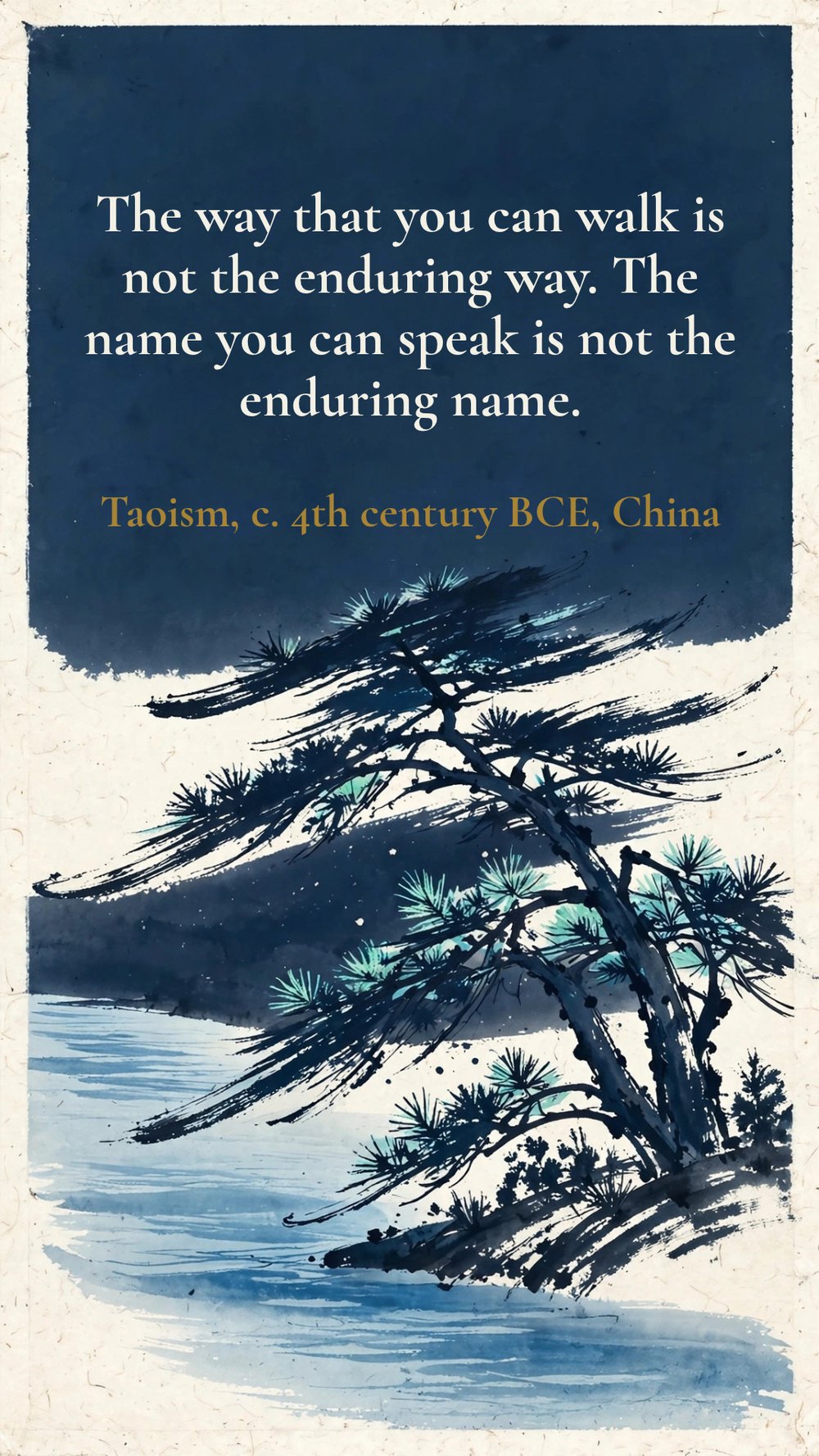
Laozi, Tao Te Ching 1
I want to point out that the paraphrasing above was chosen for the sake of clarity, and Legge's 1891 rendering lands closer to this version. However, modern translators have noted that the original Chinese reuses the same words for the noun and verb; this would say something like the way that can be wayed is not the way. Either way you slice it, I think the implication is clear that words and physical concepts fall short of fully encompassing what is going on.
I found this teaching so striking mainly because of its time and place. It is highly unlikely Plato encountered this prior to his own insight, or vice versa. Yet they both reach similar conclusions. If there is an ultimate THP, I think it would make sense that people who encounter it reach similar insights. It's important to note here that this concept of THP is very different from the father and maker. My understanding of the Tao is that it's not much of a who at all. The Tao has no intentions, makes no decisions, and wants nothing from you. The Tao is closer to an omnipresent pattern.
This fundamental difference also makes the hiddenness concept different. For Plato, THP found an epic hiding spot, and it took a long time to uncover it. For Laozi, you can't find it because it's not really an it. Whatever "it" is, it is formless and all around us. Almost like how you can't see the air but you know it's there because of the observable effects.
Later in the same chapter, this entity is called the mother of ten thousand things. Again we see another parental descriptor. This is also repeated later in Chapter 25. Paradoxically, in the same chapter Laozi calls the unnamable "The Way" or Tao (also transliterated as Dao) in Chinese, which has effectively become one of the names people will use for THP.
Hmmm, I wonder if anyone just tried asking it what its name is...
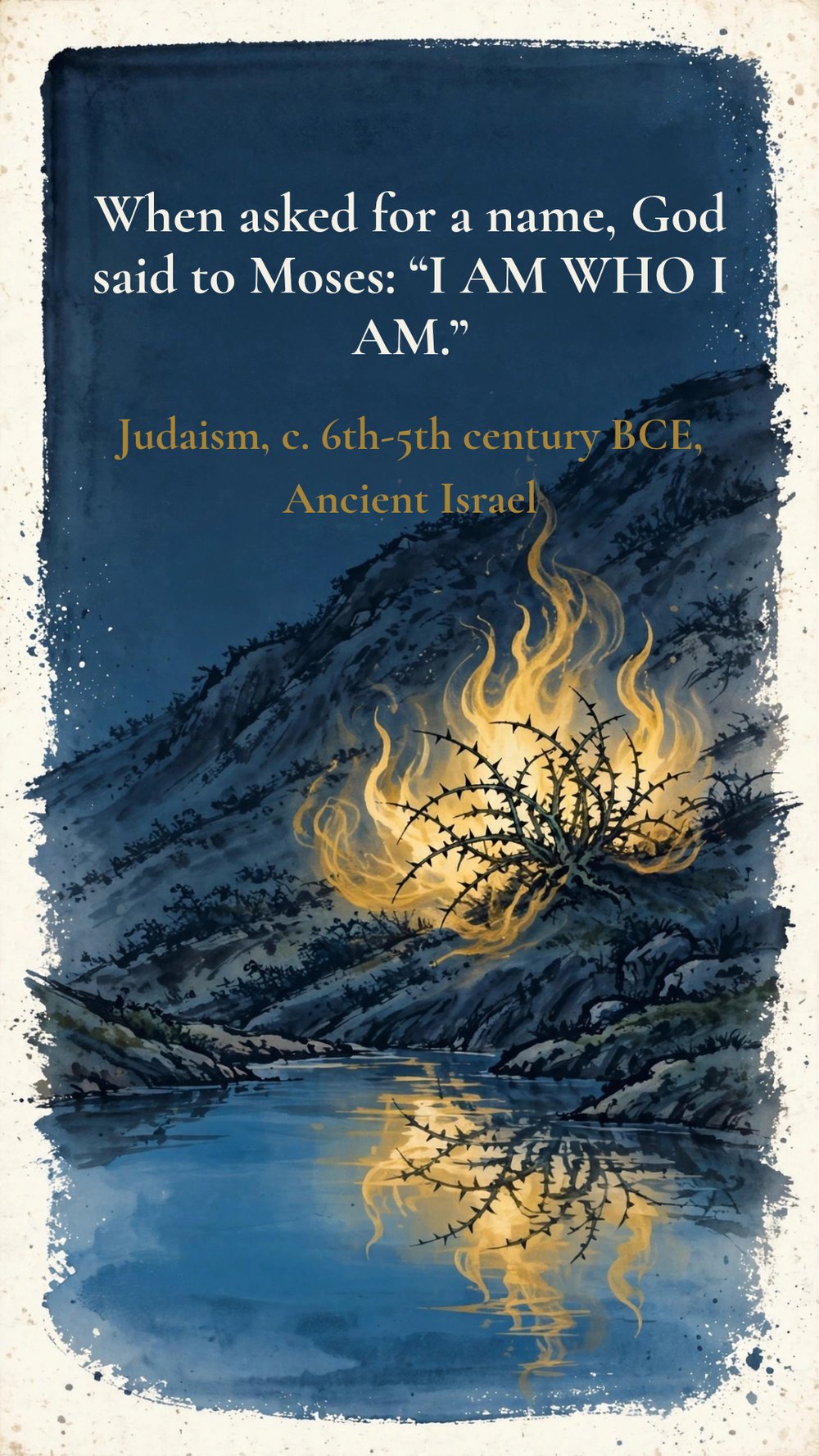
Exodus 3:13-14
This leaves a lot of ambiguity on how it should be translated. "I am that I am," "I will be what I will be," "I am being..." the list goes on for a while. I chose the version I feel is the clearest in modern English and also fairly prominent as an accepted, accurate translation. This is one of those lines that has been dissected every which way for millennia, and many serious scholars have translated it very differently. Also worth mentioning, this has been rendered in all caps in observance of the respective tradition, not because THP is yelling.
As tempted as I am to label Moses the hide-and-seek champion of the ancient world, he wasn't really looking for THP. He stumbled upon the burning bush at the age of eighty while working as a shepherd for his father-in-law. This feels much more like THP revealing itself than someone finding it. If anything, THP was doing the finding. During his conversation with arguably history's best-known bush, Moses asks for a name. Even though THP answers the request, it's still not really a name. Moreover, this is the only account I am aware of where THP directly answers this question, and, in its own way, converges with Laozi's assertion.
I also wanted to note the chronology and possible relation thus far. Laozi probably did not encounter Mosaic teachings either, or vice versa. I couldn't find any evidence to support cross-pollination.
Regardless of how you date Moses's teachings, they predate Plato, and there was also some transmission of ideas in this part of the world. An ancient philosopher, Numenius of Apamea, even said "What is Plato but Moses speaking Attic Greek?" so this rhyming has been noted many times before. However, the first Greek translations of Israelite teachings didn't come until well after Plato's death, and there is no evidence that indicates he spoke Hebrew. Is it possible there was a link? Sure, but I think it's reasonable to say that we have three separate ancient traditions arriving at strikingly similar observations.
For those of us who aren't lucky enough to stumble upon a burning bush, The Upanishads offer a technique for searching:
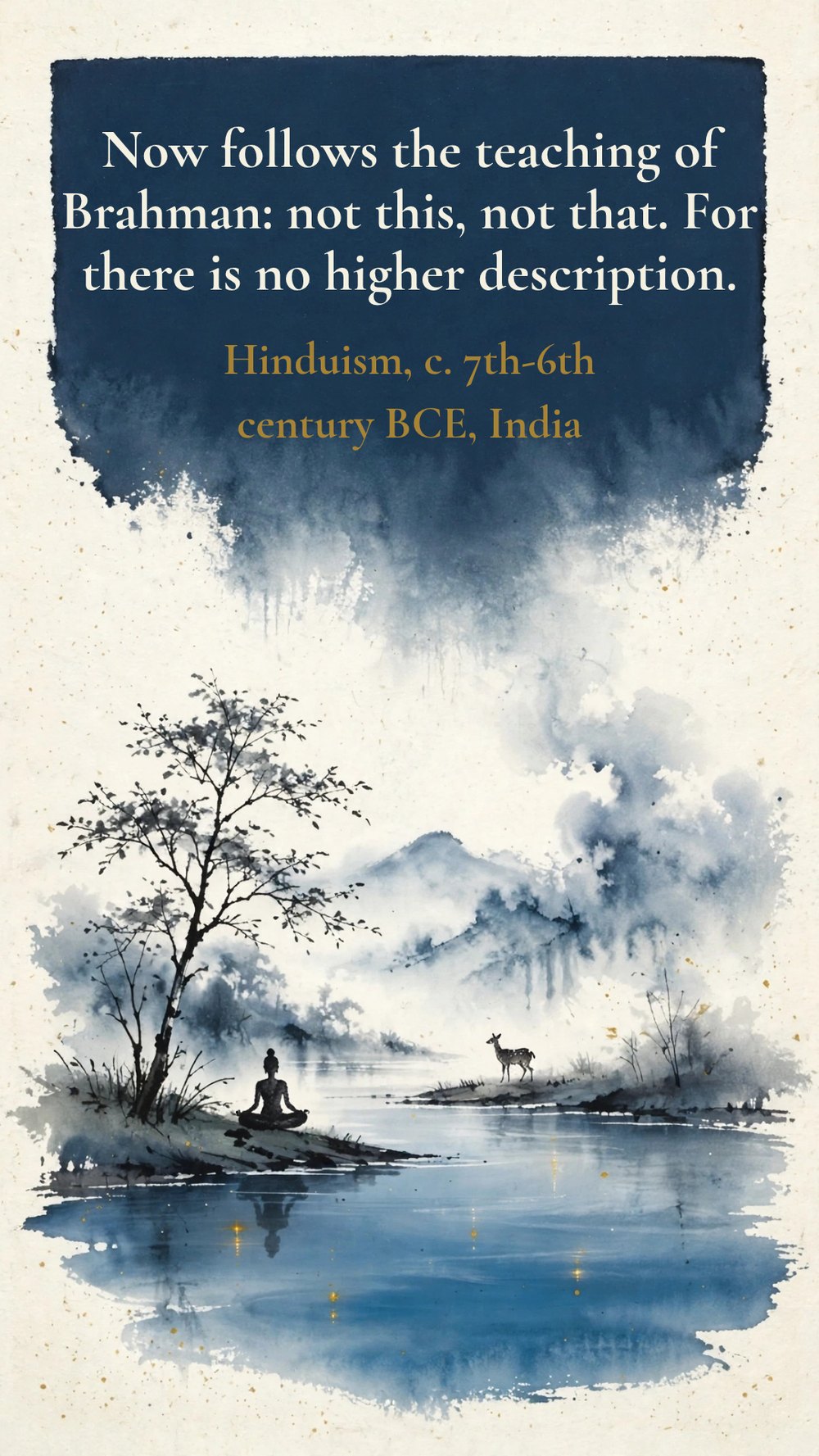
Brihadaranyaka Upanishad 2.3.6
"Neti, neti" often translated as "not this, not that" is also one of those passages that has attracted a lot of scholarly attention. Similar to the previous teachings, there are a lot of ways to translate this and a lot of ways to interpret it. Again, I can only include so much here; feel free to do additional research to more fully understand this, or the previous ones.
See? Just do that and you'll find THP in no time, results guaranteed or your money back! Okay, getting back on track, this is interesting because many people want to know what something is. This inverts that. You need to eliminate everything that isn't; what's left after that is THP. A common interpretation is that this technique applies to both the physical and the non-physical. Not the body, not the breath, not the world, not your desires, not your thoughts, etc.
This concept is known as apophatic theology, which holds that you can only know THP by describing what it isn't, and it has been promoted by notable figures of many major religions. Adi Shankara within Hinduism, Meister Eckhart within Christian mysticism, and Maimonides within Judaism, to name a few. This is not just an "Eastern mystic" practice. We have similarities to approaching THP emerging across diverse traditions.
This specific teaching makes notable departures in two areas. Many interpretations hold that one finds THP through the self, not outside oneself. No burning bushes here. Secondly, it positively declares THP's name later within the verse: "Then comes the name 'the Truth of truth'." As in Exodus, no one is introducing THP as their old friend Bob who has a bushy white beard and sits on a throne. We are given a "name" that's kind of a name, kind of a description, and kind of none of the above. With answers like these, we can't help but be left with the feeling that this is a topic where the words and concepts we are familiar with fail to convey the idea of what is being discussed.
Our next teaching plays with another word beautifully.
Jesus of Nazareth, John 14:9
Firstly, we have our final instance of the parental affiliation theme. Worth noting that this has now appeared in three distinct traditions. The second theme I want to look at is that of "seeing." This runs throughout John's gospel and it's clear that there's a difference between seeing something physical with your eyeballs and seeing something in a way that conveys understanding. This teaching was delivered when one of Jesus's disciples, Philip, asked him to show them the Father. Presumably expecting to physically see something miraculous, Jesus's response instead implies Philip's lack of understanding.
Chapter 9 provides a great example of the double entendre of sight. In this chapter, Jesus encounters a man born blind and restores his sight; then the Pharisees detain and interrogate the man. In this exchange the Pharisees ask the formerly blind man who healed him and whether Jesus was a sinner. The blind man readily admits what he does not know; he just knows a man called Jesus restored his sight. The Pharisees become irate as their understanding is shown to be lacking and throw the man out.
Throughout the chapter, the formerly blind man demonstrates a progression of understanding. First he describes his healer as "a man called Jesus," then "a prophet," then says he must have been sent from God, and finally worships Jesus when they reencounter each other. This ending implies the chapter's pinnacle of understanding.
Conversely, the Pharisees demonstrate their blindness in the understanding context. In spite of the fact that they can physically see Jesus and a man whose sight was restored, they grope in the darkness. They ask the man about how his sight was restored, then his parents, and then the man a second time. The whole time they cannot see what is in front of them. Their story in the chapter ends with another verbal scourging from Jesus. When they ask Jesus if they are blind, Jesus gives them a paradox: if they were blind, they would have no sin; because they claim to see, their sin remains. It's their hubris, not their ignorance, that is the sin.
Very interestingly, within the same gospel, we have the claim that no one has ever seen God (1:18). Another paradox when we place these two passages side by side. I'm not going to take a firm position on solving this one. However, I think there are a few possibilities: perhaps John meant no one has seen God with their eyeballs; perhaps no one actually lived up to Jesus's standards of understanding; perhaps he was using it in a context similar to the final teaching.

Qur'an 6:103
I want to make a note on the verb used here. This can also be translated as vision cannot encompass him (among other translations, you get the point on my translation disclaimers). I read this as: your perception cannot contain him. I think this really gets at the heart of our earlier teachings. Even when THP is claimed to be found, what are we left with?
I got 99 names but something everyone agrees on ain't one. We have descriptions that have puzzled scholars for generations. Then there are texts that scholars continue to debate and many of us struggle to grasp. If full understanding were easy, or even possible, it's likely someone could have conveyed that total understanding by now in a way that, well, many people could actually understand. However, the fact that people like me are writing stuff like this suggests the search goes on. To me, this indicates that either we haven't understood THP yet or it's just not possible. Whether it's the Rosetta Stone waiting for its aha moment or we're basically dogs trying to work an iPhone, who knows. However, I think it's safe to say where this teaching stands.
Another reason I wanted to end on this one is because it's the only teaching today that flips the script. All the other ones have focused on someone trying to perceive THP; this one also points to THP's role in understanding us. Picking up the Abrahamic thread from Exodus, THP also seems to have a role in the finding. Personally, this teaching leaves me with a feeling that trying to find THP is like trying to swim upriver. Not impossible, but certainly very difficult. Meanwhile THP's understanding floats effortlessly with the current. However, now we're starting to flow into a conversation about omniscience. That's a topic worth its own writing, so we'll just have to end it here.
Olly Olly Oxen Free
Maybe THP is hiding, maybe it's waiting for the right time to reveal itself, or maybe we're limited seekers. Some of history's most influential thinkers ran into limits. Plato and the Upanishads couldn't describe it in a straightforward way. Laozi couldn't name it. Moses tried to get a name and got a riddle we still haven't solved. Finally, the Qur'an states our limitation most directly: our vision does not encompass it.
Names, words, senses, and intellect all seem to be too small. Maybe size is the problem. A cup can hold some river water, but it can't hold the river. Maybe the goal isn't to find the vantage point that lets us see the whole thing. Maybe we need to enjoy the view we have, stay humble about what we can't see, and then keep looking.
Personal Commentary
Most of us probably won't fully grasp THP, whatever it is. However, most of us can bring that same humility when approaching other people. No matter how well you know someone, you can't read their mind. You probably don't know everything about their history. You may not know what sort of day they're having. You may understand a lot, but your vision does not encompass them. Bring the same humility to understanding others that this search requires of us. Maybe there's a part of THP in there waiting to be found. If we all started our search there, we'd probably see something worth finding.