The Higher Power
Big Data
October 2026
All passages below are my paraphrases from public domain translations, condensed for readability. Citations are there so you can check them. Specific numberings can vary across editions and translations. Dates cite textual compilation rather than the time of the teaching, if those vary.
"If it's free then you're the product." We've all likely heard this as a way to summarize big tech. However, "data collection" has much, much older roots and has been discussed by some of history's sages. No, the Buddha wasn't talking about what your 3 a.m. search history looks like when you can't sleep.
These timeless traditions were talking about much deeper data. They wanted to know if your actions, thoughts, and intentions were being collected. They wanted to know who or what was collecting this data, for what purpose, or if anything was even being collected.
First, let's start with a source that sounds almost as spooky as "big tech."
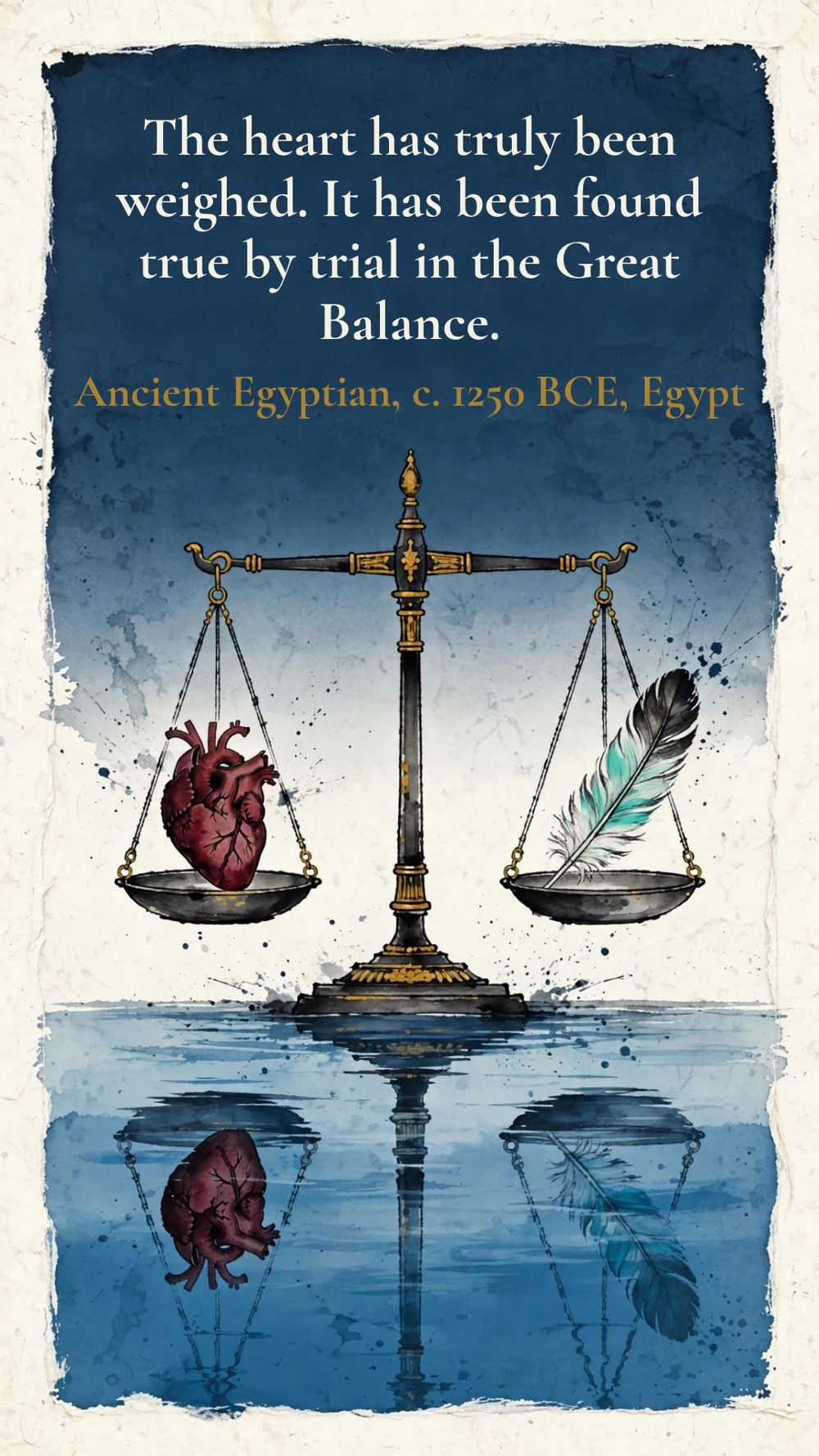
Book of the Dead, Spells 30B and 125 (Papyrus of Ani)
Before we dive into these teachings, we need a brief detour on the ancient Egyptian afterlife for it all to make sense. In order to get into the Field of Reeds (the good afterlife), you had to pass a series of gates. Getting to each gate was basically a video game dungeon: get the ferryman to help you cross the river, avoid crocodiles, dodge the snakes, don't get maimed, etc. Then each gate had a guard whose name you had to speak correctly (knowing someone's secret name gives you some amount of power over them in Egyptian lore). The final boss is a trial in the Hall of Two Truths.
As you have no doubt guessed, your heart is placed on a scale counter-balanced against Ma'at's feather. In Egyptian lore, Ma'at represents truth and order while the heart was the center of your thoughts, memories, intention, and character. Also present in the courtroom is Thoth, who essentially acts as the stenographer and later announces the verdict. Anubis oversees the scales. Ammit is the menacing executioner waiting in the corner. There are forty-two additional judges that assist in the verdict. Finally, Osiris oversees the proceedings. Pass the trial and you live happily ever after. If you're found guilty, Ammit eats your heart and you cease to exist.
The Book of the Dead is a really fascinating source and very different from our other ones. It's actually a collection of almost 200 "spells" written on papyri which were found in various tombs. No two copies have the same selection; each was individually commissioned. These were instructions, passwords, and "spells" to help get you past the gates. Moreover, every papyrus depicted the owner as passing the trial. This feels like buying the cheat codes to the Underworld.
Spell 125 is instructions on what to say in the Hall of Two Truths. It gives the names of the forty-two judges (again, very powerful stuff) and what to say to each of them. Largely, the instructions are moral, negative declarations (I did not murder anyone, I did not commit adultery, etc.). These are basically your opening remarks written down, so you don't have to memorize them and say exactly the correct things to help your case.
Spell 30B I found absolutely fascinating. It is actually an appeal to your own heart not to testify against you. The heart knows everything you did. This spell is begging the star witness not to tell the courtroom everything it knows. It also invokes those moments when "our heart" wanted something that we knew wasn't in our own best interest.
For our Big Data metaphor, the Egyptian tradition has a unique structure compared to the other teachings we will look at. First, Thoth seems to maintain a non-omniscient external database of the trials. Then we have the heart, which records all the user data locally: thoughts, memories, and intentions all get logged here. However, the spell implies that the user has some amount of control over what gets uploaded and reviewed by external entities. This feels like asking the star witness to keep a few things secret. The judge and jury don't need to know about that thing we did last summer, right?
In our next teaching from a nearby part of the world, the courtroom looks a little different.
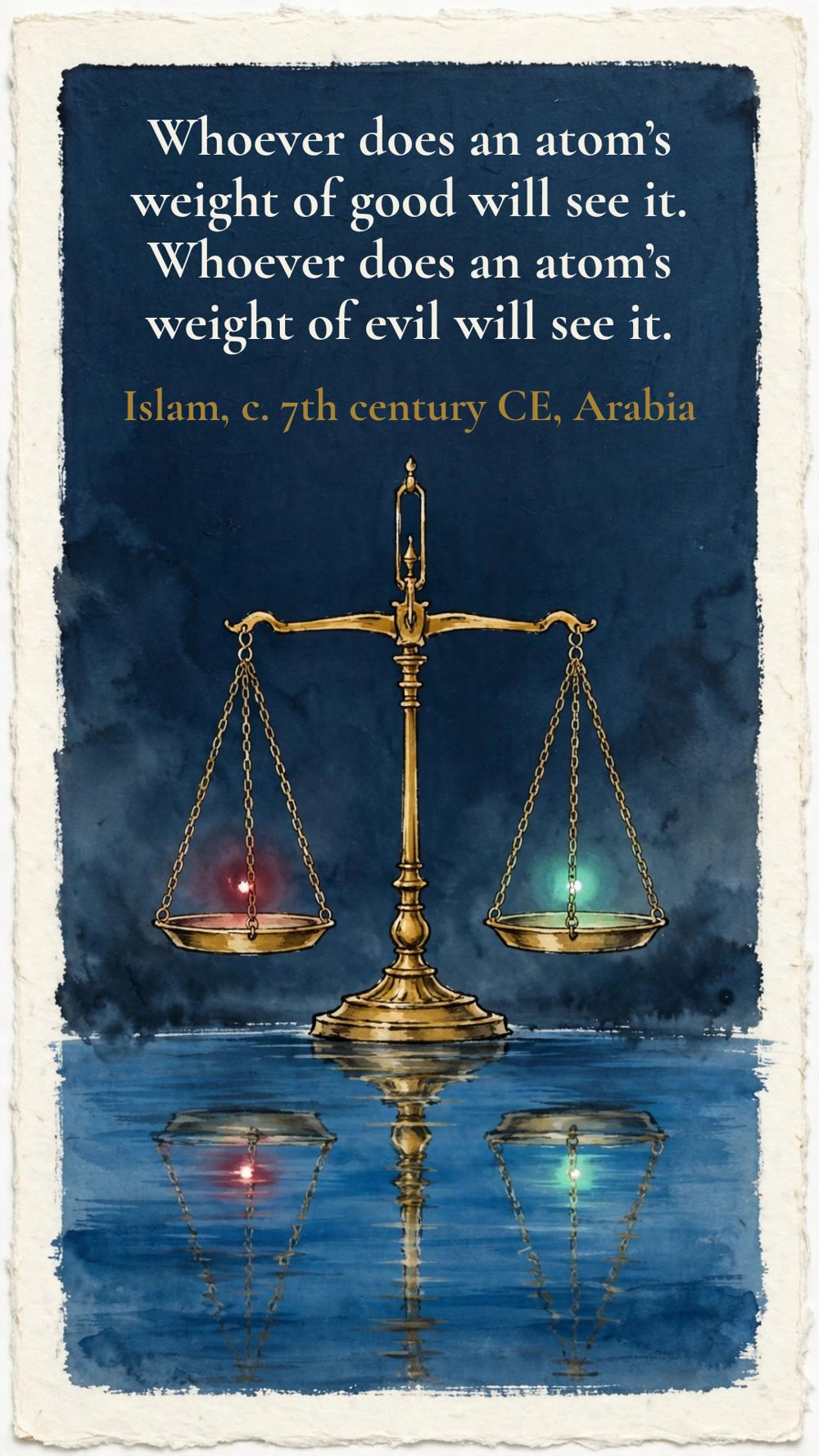
Qur'an 99:7-8
To help complete the picture of the Quranic view on our deeds, I want to bring in a couple more verses. 50:16-18 state that Allah is nearer to one than one's own jugular vein and knows one's thoughts. It goes on to describe two recorders; tradition holds that one captures all the evil deeds, the other all the good. 21:47 tells about weighing the scales during the final judgement and how it will be just. Similar to the "atom's weight," this verse mentions that even a mustard seed's weight is brought forward.
In a parallel to the Book of the Dead, we also have more body parts testifying against their owners. Verses 41:20-21 depict a scene of ears, eyes, and skin testifying at the final judgement. The people ask their skin why it is testifying against them, and it responds that it was Allah (simply Arabic for God) who gave it speech. The creation answers to the maker, not the temporary owner. This is an interesting difference. Our Egyptian teaching allowed the owner to beg the heart not to testify, but there won't be any witness tampering in Allah's court.
I read these four passages as a summary that Allah has the perfect data set. Under this system no detail is too small, everything is logged, and there will be a just accounting according to Allah's standards. No gaming the system with secret names here.
The Book of the Dead teaching reads to me as someone uploading their life file, then an entity reviews it. There's no upload here. The file was already written in real time. Now Allah will review once you're done writing your data.
Both traditions so far agree that consequences you don't see in this life will still reach you. The next tradition reframes what "afterlife" means, but it holds to the same principle: you will see the fruits of your actions.
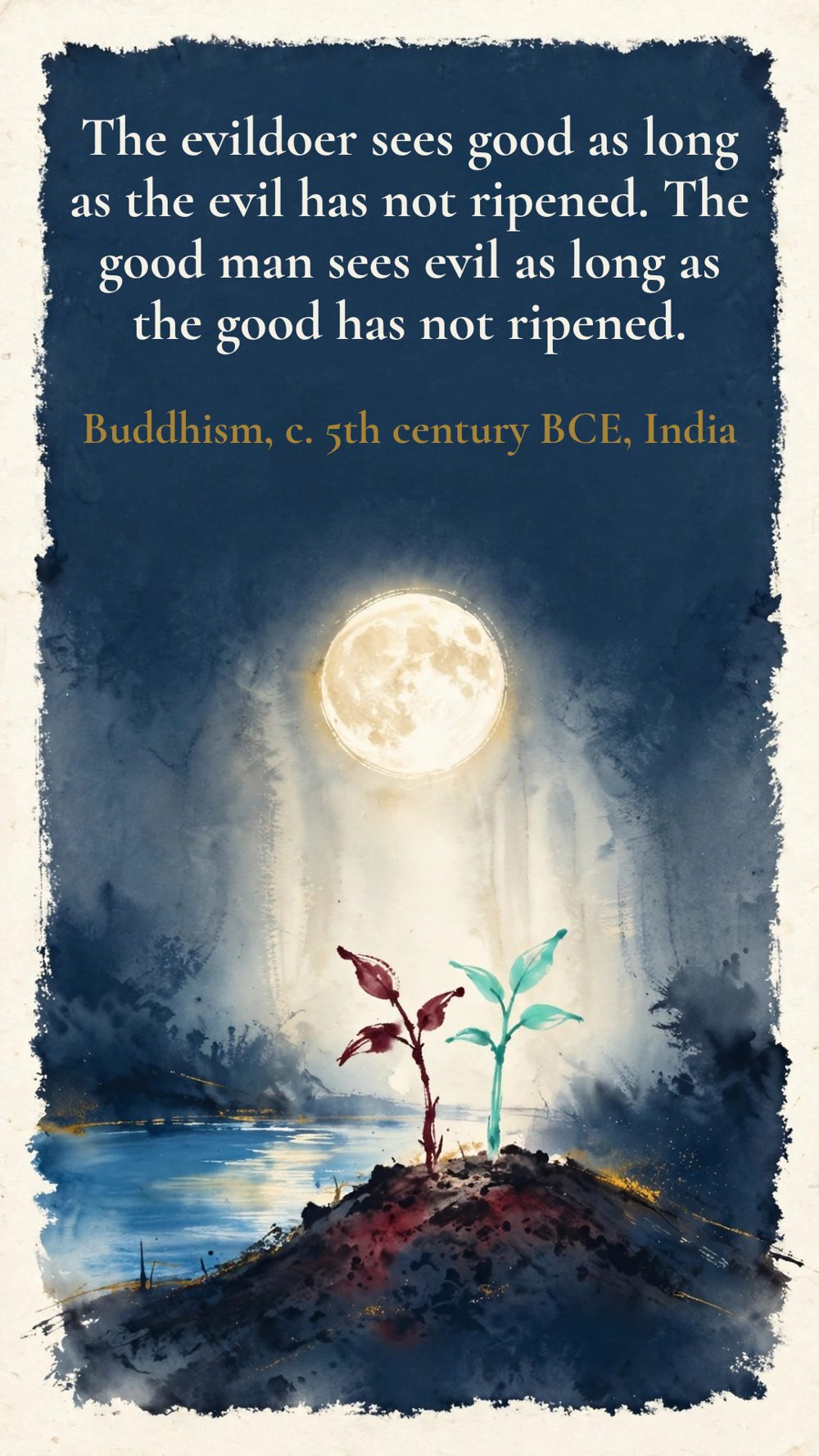
Dhammapada 119-120
The Dhammapada Commentary carries an interesting story behind these teachings. A wealthy patron, Anathapindika, generously supported the Buddha. He eventually became impoverished, but continued giving what he could. During his poverty, a spirit came to harass him and ask why he would continue to donate.
The spirit is expelled and seeks help from the king of the gods. He advises the spirit to make amends by writing out a list of the wealth Anathapindika once possessed, then restore it. The spirit finds some of Anathapindika's family wealth that was swept into the ocean, undiscovered treasure, and convinces some merchants to pay their debts owed; the wealth is equal to all the money he ever donated to the Buddha. Afterward Anathapindika takes the spirit to the Buddha, who then delivers his lesson on delayed consequences.
Many people have a misconception that karma is one word for saying what goes around comes around. Karma is defined as action. However, in Anguttara Nikaya 6.63, the Buddha states that karma is actually intention. It's not the act that comes back around, but the intention. If you hit someone out of anger, you may not necessarily get hit, but the fruit of your anger will come back as some form of suffering once it has ripened.
Very importantly, this teaching speaks to the delay in consequences. Getting your student loan payments paused during COVID didn't make them go away. The data has already been logged. You'll keep on living while the system is processing, but that data is still there.
In the previous two sections we saw a willful, conscious entity rendering judgement. It felt like a programmer reading the file, then inputting a prompt that had an immediate effect on the program. While the exact workings of karma are mysterious, this feels much more like an algorithm. No higher level input is needed; the system finds a way to bring the consequences to fruition.
Next up we'll have another lesson on debt in a teaching that sounds a lot like karma.
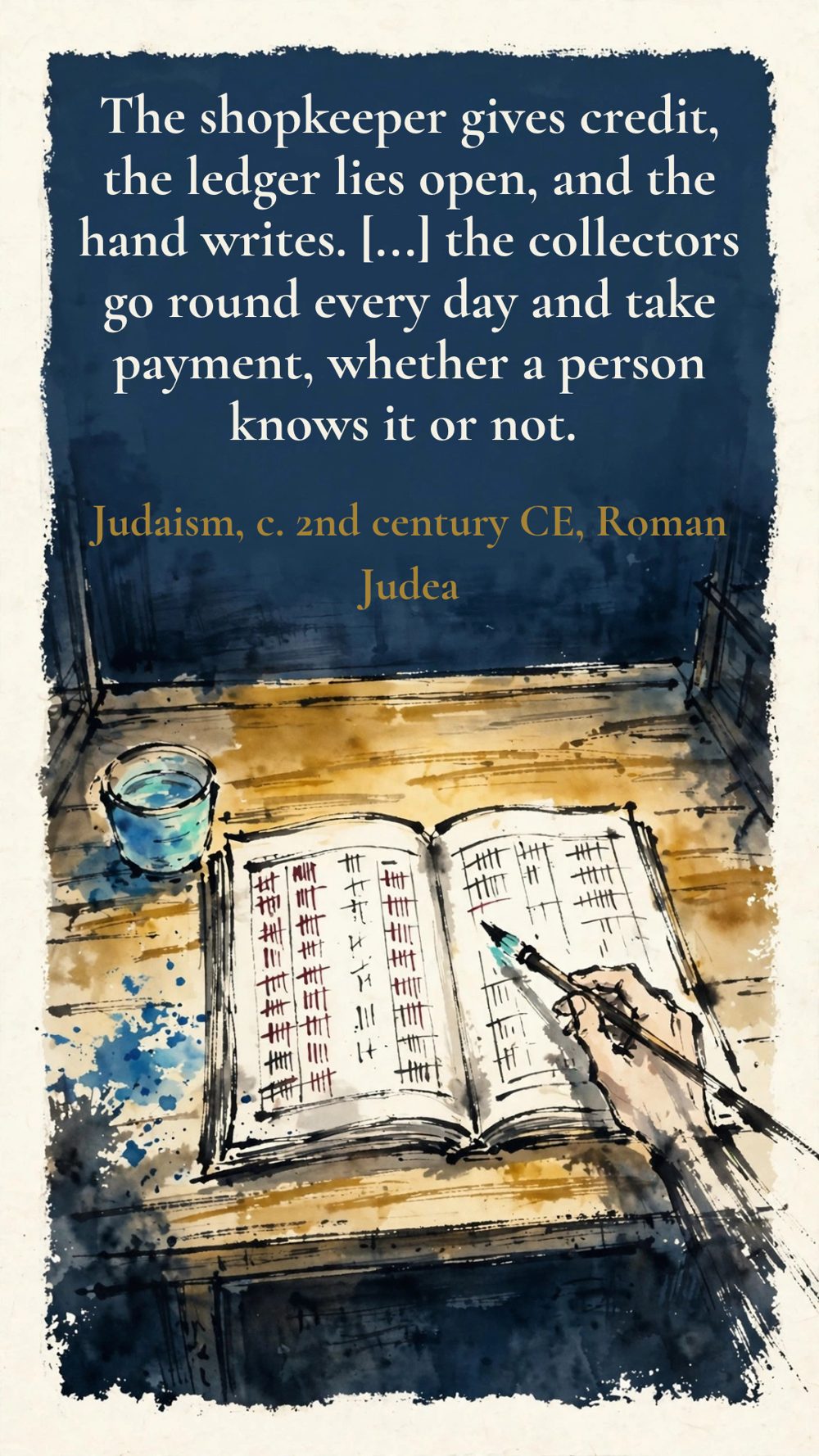
Rabbi Akiva, Pirkei Avot 3:16
Another accounting that must come due. This teaching rhymes with Buddhist karma, and also mentions that the loan collecting is both delayed and difficult to tie back to the action. I expect both traditions would say this is one reason "evil deeds" can percolate so easily. If all our noses grew every time we lied, we would probably live in a much more truthful world. However, time can blunt our ability to connect cause and effect.
Similar to the Quranic section, this also depicts a perfect data system. The shop is always open, the hand is always writing, and everything is given on pledge. No amount goes unnoticed. In addition to an Abrahamic final judgement (Ecclesiastes 12:14), it adds incremental collection. This is a hybrid system. The auto-drafting algorithm handles the day-to-day accounting. Then Higher Power input at the final judgement settles the account once and for all.
I also want to note the "shopkeeper gives credit" part of the teaching. The full teaching actually goes a bit further and says that everything is given on pledge. This echoes the concept seen in the Quran about body parts testifying against owners. In this shop, you can't buy anything; you just have to pay the subscription fee. Once your account is canceled, you can't access all those cool things you accumulated because you never owned them in the first place.
Our next teaching does away with scales and bookkeeping but keeps the fruit.
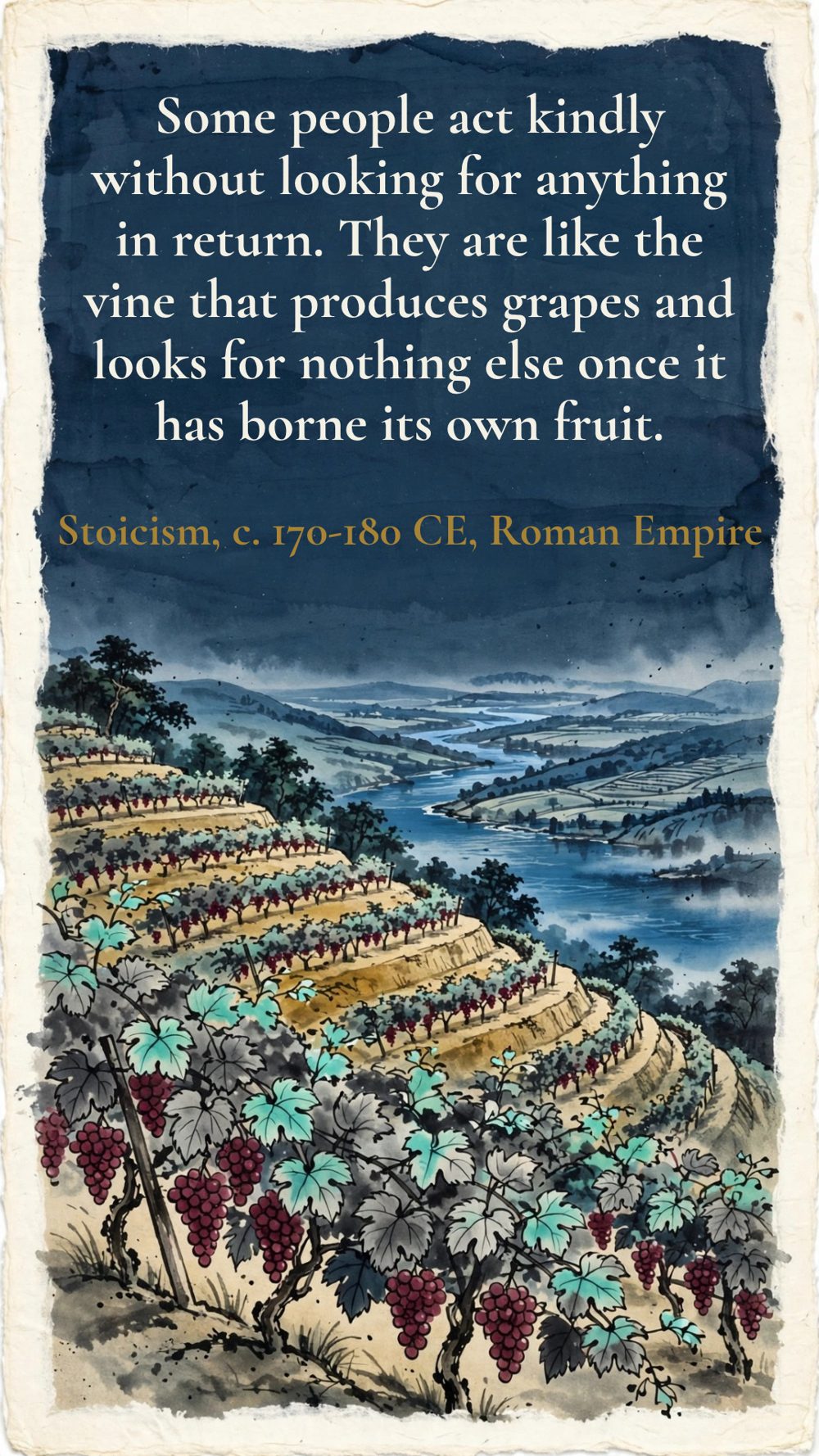
Marcus Aurelius, Meditations 5:6
What Meditations lacks in postulations about a heavenly afterlife, it more than makes up for in terrestrial advice. One shouldn't do good because one expects anything in return; do good because it's the right thing to do. Don't overcomplicate it. The reward for taking the high road is that you get a better view than the low road, not that it takes you to a different place.
Note, there's no data here. No scales. No ledgers. Nothing is logged by some overarching system and there's no one trying to eat your heart for being naughty. Just a simple reminder from an emperor to himself (the prevailing opinion is that Meditations was meant to be a private journal, not for later publication).
Interestingly, Marcus continues this teaching by having a little debate with himself. He asks the question, isn't it natural for a social being to want others to be aware of what one is doing? His response to himself: to ask the question shows a lack of understanding (of his own point, ironically). I think this vulnerability is a great example of what has made Meditations a timeless work. Even history's most memorable people can have an internal back and forth where one debates oneself and wrestles with what one should do.
Another impactful detail: given Marcus's station, he was the one person in these teachings that could have thoroughly collected from his ledger. He could have kept score and collected every debt. Judging by some of the later emperors, he may have even been able to have someone eat a heart.
But he didn't. He advocated for giving out favors pro bono and doing the right thing. Unfortunately, he was the last of the "Good Emperors" and was succeeded by his son Commodus. In addition to being the villain in the original Gladiator, he didn't make it into the Good Emperor club which tells you something about him.
Ironically, Marcus's virtue and good deeds did not ensure a fortunate outcome for Rome. Maybe Rome was carrying a balance that five good men couldn't pay off in time. Maybe there were other seeds planted long ago that ripened. Maybe they were all just straw dogs.

Laozi, Tao Te Ching 5
One doesn't have to read too much of the Tao Te Ching to run into the phrase "straw dogs." This actually does not imply a lack of caring; it's more of a non-attachment than apathy. Zhuangzi chapter 14 gives some necessary background; straw dogs were ceremonial objects. They were treated with respect before and during the ceremony, then discarded afterward. Often people gathered them back up for kindling.
We have a tendency to equate "not humane" with cruelty. However, I feel this is more of an implication that heaven and earth are just not human. Chapter 2 defines the world in terms of complementary and mutually defining opposites. In this case, cruelty only exists when compared against benevolence.
The text does not portray heaven and earth as exercising human-style characteristics. They just are what they are, and as much as we want to label them, the labels don't quite fit. I read these forces as not being willful conscious entities. They more closely resemble gravity than anyone you know.
I'm not sure which outlook is more appealing. A perfect system that logs every deed and thought, or a system where none of it is logged and everything just is what it is. Either one can be a little bleak depending on one's inclination. Fortunately, there are also ample silver linings that we are going to look at.
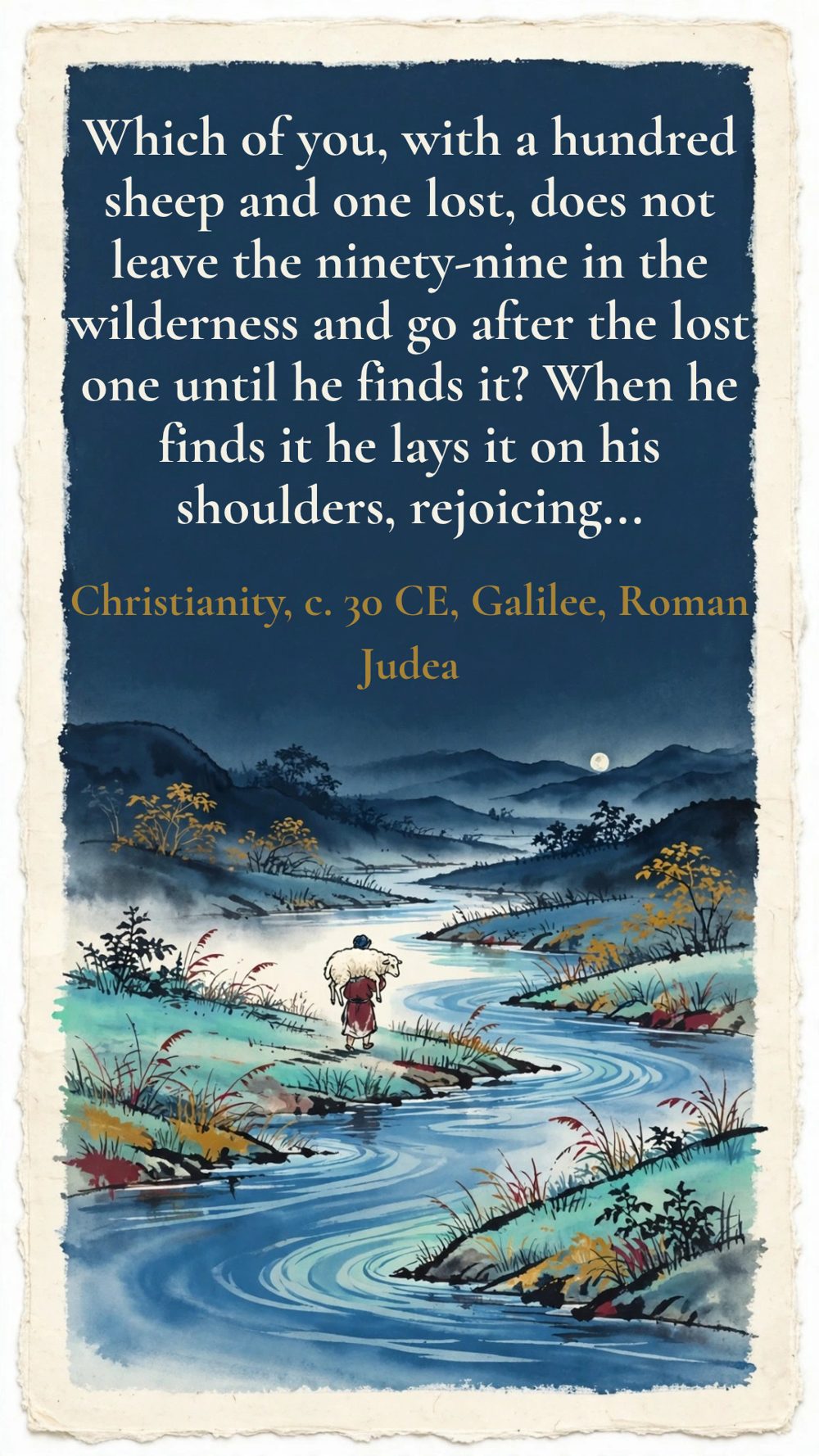
Jesus of Nazareth, Luke 15:4-7
All our talk about ledgers and scales probably had some of us trying to calculate exactly how much money we have to donate to balance out that thing we did in our youth and still regret. Fortunately, we have a teaching that is thoroughly unmathematical. Jesus's parable of the lost sheep is one of the embodiments of Christian grace as it portrays the lost sheep as being a sinner who repents.
It's the impracticality that drives the point home. Leaving ninety-nine sheep alone in the wilderness is not typically considered the best shepherding. However, no one gets written off in this accounting. The shepherd goes searching. Besides repentance, the sheep did nothing to earn its salvation. Yet the shepherd picks it up and carries it back. Whereas most people would have rejoiced that they still had ninety-nine sheep, here the rejoicing is over the one that was found. This is not the bookkeeping of a miser who wants to collect every outstanding penny.
Grace that overrides the ledger may sound uniquely Christian. However, it also turns up in a tradition built on karma, one of the most automated accounting systems we've looked at.
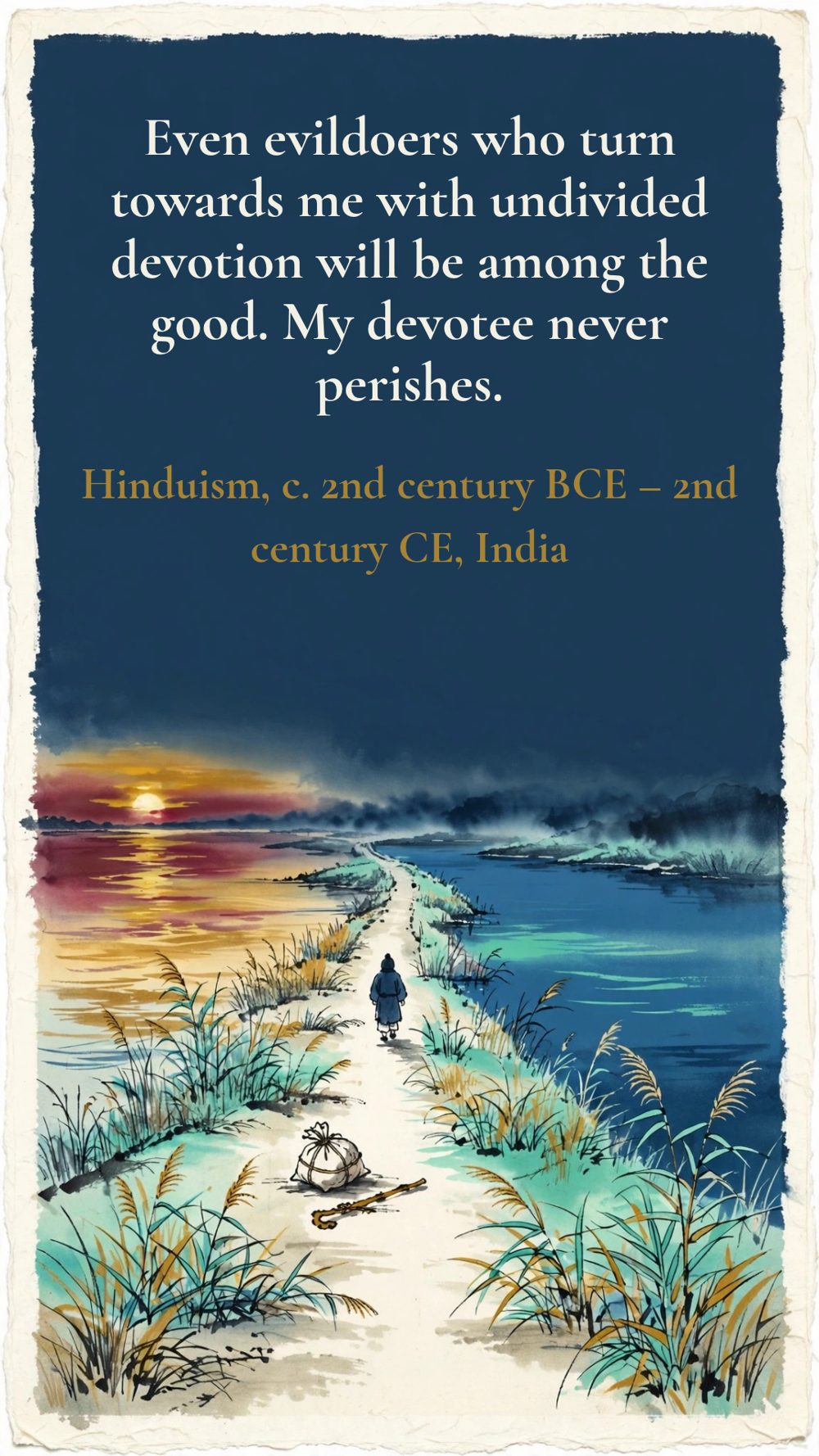
Bhagavad Gita 9:30-31
It's worth noting that there isn't any widely accepted evidence I could find which would indicate that these teachings were influenced by each other. I think it's likely that we have separate theistic sages reaching similar conclusions about divine forgiveness. Similar to our Christian parable, this depicts an entity that is more ready to pardon than condemn.
In another interesting parallel, in Matthew's version of the parable (18:14), Jesus's conclusion is "it is not the will of your Father […] that one of these little ones should perish." There is deviation across translations, so I don't want to put too much weight on both teachings using the word perish. However, I find it fascinating that we have two unique traditions focusing on the Higher Power's willingness to forgive.
Specific to our Hindu teaching, note that it doesn't focus on one's behavior. This is about inner transformation. Steadfast devotion is more of an inner state and less of something you can do. Then, after you reach that level of devotion, righteous behavior follows and the person becomes righteous.
Our final teaching comes from a familiar source, but leaves out the straw dogs this time.

Laozi, Tao Te Ching 79
Since our previous Taoist teaching could read a little nihilistic, I also wanted to include something more positive. I find it fascinating that one of our least willful higher powers still sides with the good. To me, this teaching has the feeling of water gathering in a valley.
Neither gravity, nor water, nor the earth acts willfully. However, when water starts on the high ground it flows to the low ground. It doesn't need an input, that's just the only logical outcome given the confluence of forces. It's as if this teaching is implying something similar. The Tao isn't putting its finger on the scale, favoring the good is just how the system works. No divine intervention required.
We've seen a lot of theories about what happens to our life's data. From omniscient programmers providing inputs, to algorithms initiating slow moving machinations, someone wiping the drive in our favor, to no system at all, and even a couple in between. We ask what big tech is doing with our digital data; similarly, it's natural to ask the same of the Higher Power.
Where does the data go? How can we delete the data we don't like? Does the Higher Power even care? If life is free, are we the product? Or are we just unknowingly adding tallies to our ledgers? Would any of those answers change our behavior?
All questions worth asking. I think the question I ask myself is how do I add some more of the good? I don't know if there is a ledger. It's hard to say if the high road has a better view than the low when you can only walk one at a time. Maybe I'm just another straw dog whose ceremony isn't over yet. However, almost every teaching in its own way agrees that you should go try to do some good. If there are some sweet karmic fruits out there, let's go get them. If there is going to be a trial, let's stack the evidence in our favor. If there isn't anything, then we still have the good we did for others.